Company Purchases: A Professional Guide to Limited Company Conveyancing in 2026

Did you know that the majority of new buy-to-let mortgage applications are now made by limited companies rather than individuals? It's a strategic shift that makes sense for tax efficiency, yet the legal path to completion is often far more complex than a standard residential sale. You're likely aware that lender requirements for corporate entities can be incredibly demanding, often leading to frustrating delays and confusion over personal guarantees.
We understand that you need a solicitor who speaks the language of both property and corporate law. This guide provides the expert legal oversight you need to manage your company purchases with confidence and clarity. We'll show you how to secure a smooth, legally compliant transfer of property into your corporate entity while ensuring total transparency regarding lender conditions. From navigating the 17% SDLT rate on dwellings over £500,000 to managing the fast-paced requirements of bridging loans, we've outlined everything you need for a successful acquisition in 2026.
Table of Contents
Understanding Company Purchases in the 2026 Property Market
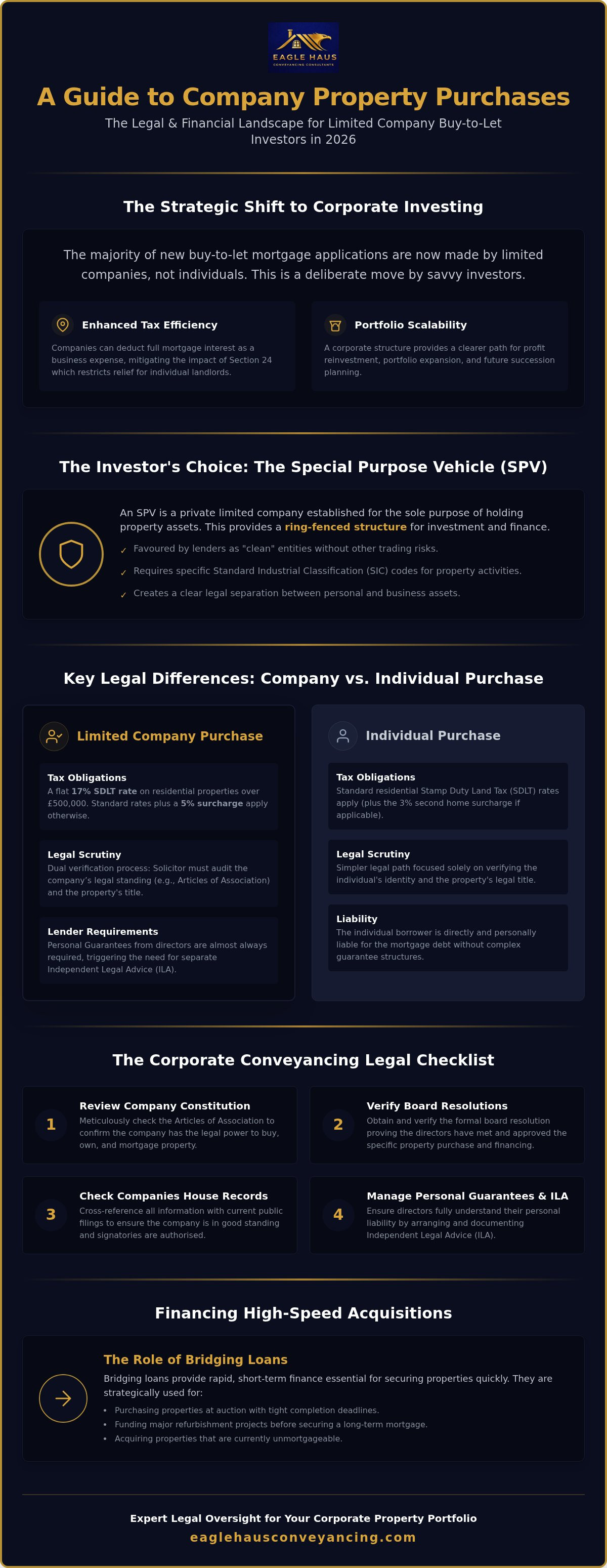
In the current market, company purchases represent a sophisticated shift in how residential portfolios are built and managed. Rather than buying in a personal name, investors use a corporate entity, typically a Special Purpose Vehicle (SPV), to acquire property. This isn't just a different way to sign a contract; it's a fundamental change in the legal nature of the transaction. Whilst a standard home purchase focuses on the individual, a corporate acquisition requires a detailed audit of the company's legal standing and its authority to enter into debt.
Investors in 2026 favour these structures primarily for tax efficiency and scalability. Following the continued impact of Section 24, which limits mortgage interest relief for individuals, the ability for a company to deduct full mortgage interest as a business expense remains a significant draw. Tens of thousands of new property SPVs were incorporated in 2025 alone, reflecting a clear trend towards professionalised, corporate-held portfolios. This approach allows for easier profit reinvestment and provides a clearer path for future expansion or succession planning.
The Rise of the SPV in Property Investment
For investors targeting high-growth areas like Birmingham and Wolverhampton, the SPV has become the standard vehicle for growth. These entities are favoured because they are "clean" in the eyes of lenders, as they don't carry the trading risks of a standard limited company. Setting one up involves specific SIC codes (Standard Industrial Classification) that signal to banks that the business exists solely for property activities. In the 2026 market, a Special Purpose Vehicle is a private limited company established for the sole purpose of holding property assets, providing a ring-fenced structure for investment and finance.
Corporate Governance and Property Law
The conveyancing process for a corporate buyer is significantly more rigorous than a traditional purchase. Your solicitor must verify that the company actually has the power to buy property and, more importantly, the power to charge it as security for a loan. This involves a meticulous review of the company’s Articles of Association. If these constitutional documents are outdated or restrictive, they can block a transaction entirely until they are formally amended.
We also manage the verification of corporate authority through board resolutions. Lenders require proof that the directors have met and formally agreed to the purchase and the associated financing. We cross-reference all information with current Companies House filings to ensure the company is in good standing and that the individuals signing the deeds are legally authorised to do so. This proactive oversight prevents last-minute hitches that often plague less experienced buyers during company purchases.
Key Legal Differences: Limited Company vs. Individual Purchases
When you transition from personal ownership to company purchases, the legal landscape shifts dramatically. It isn't just about who holds the title; it's about how the law and the tax office view the transaction's risk profile. Tax obligations are immediate and often more substantial for corporate bodies. For residential properties costing more than £500,000, companies currently face a flat 17% tax rate. Even for properties under this threshold, you'll pay standard residential rates plus a 5% surcharge. You can review the current Stamp Duty Land Tax (SDLT) rates to understand how these surcharges impact your initial capital requirements.
The legal path for a company involves a layer of corporate transparency that individuals don't face. Your solicitor has to verify the company's constitution alongside the property's title. This dual focus ensures that the purchase doesn't breach any internal company rules or external regulations. It's a more methodical process that requires a conveyancer who's as comfortable with Companies House filings as they are with Land Registry deeds.
Lender Requirements and Personal Guarantees
Lenders view corporate entities as higher risk because they lack the direct liability of an individual. To mitigate this, almost all banks demand a Personal Guarantee (PG) from the directors. This means that whilst the company owns the debt, you're personally responsible if the company defaults. This requirement triggers a specific legal step called Independent Legal Advice (ILA). A solicitor must meet with you separately from the company's representation to ensure you fully grasp the risks. We prioritise clear communication here, making sure you understand the balance between corporate liability and your personal assets.
AML and Enhanced Due Diligence
Anti-money laundering (AML) checks are significantly more intrusive for corporate buyers. We don't just look at the company's bank statements; we have to "look through" the corporate structure to the ultimate beneficial owners. This often involves:
Providing evidence of the source of wealth for any shareholder with a significant stake.
Verifying the trail of funds used for the deposit, often going back several months.
Ensuring compliance with the Register of Overseas Entities if the structure involves international elements.
These checks can cause major delays if they aren't handled with a proactive mindset. Modern investors prefer a digital-first approach to identity verification to avoid the slow exchange of physical documents. If you're planning your next acquisition, choosing a specialist in limited company conveyancing can help you organise this paperwork early. We ensure your corporate identity and funding proofs are verified well before the exchange date, keeping your investment timeline on track.
Choosing the Right Conveyancing Partner for Your Portfolio
Selecting a legal partner for your property portfolio requires a shift in perspective. When you move beyond a single home to managing multiple company purchases, you need a solicitor who views your transactions as business assets. Speed is often the most critical factor for professional investors. A delay of just a few days can jeopardise a financing deal or result in a missed auction deadline. You should look for a firm that offers fixed-fee structures rather than hourly rates. This transparency allows you to calculate your yield and ROI with total precision before the transaction even begins.
Specialist vs. Generalist Solicitors
A general residential solicitor may lack the specific experience needed to handle complex corporate finance clauses or the nuances of Stamp Duty Land Tax rules for companies. Specialist firms understand that modern investors often rely on bridging loans to secure properties quickly before refurbishing and refinancing. We provide this specialist oversight through Eagle Haus, combining a modern, proactive approach with the robust regulatory backing of Taylor Rose. This synergy ensures your deals move at the speed of the market whilst remaining fully compliant with professional standards.
Local Expertise in Staffordshire and the West Midlands
Regional knowledge is indispensable when acquiring property in areas like Birmingham, Wolverhampton, or Telford. Every local authority has unique requirements for searches and planning permissions. In Staffordshire and parts of the West Midlands, specific environmental risks such as historic coal mining activity can complicate a purchase if not identified early. A conveyancer with local roots understands these regional quirks. They ensure that searches are ordered correctly and interpreted with local context.
This expertise also becomes vital when you need to restructure your holdings. Whether you are moving assets between companies or adjusting ownership shares, having a partner who understands transfers of equity within a portfolio context is essential. We help you navigate these transitions smoothly. This ensures that your legal structure always supports your long-term investment goals without unnecessary friction.
Managing Finance: Bridging Loans and Lender Requirements
For investors looking at company purchases in 2026, bridging finance is often the primary tool for securing undervalued assets. Whether you're bidding at auction or targeting a property in need of significant refurbishment, the standard mortgage process is simply too slow. Bridging loans provide the necessary liquidity, but they come with rigorous legal requirements that differ from standard term finance. Your conveyancer must act as the central hub, coordinating between the lender's legal team, your broker, and the company directors to ensure every condition is met within a matter of days rather than weeks.
A crucial part of this process is verifying the exit strategy. Lenders won't release funds unless there's a clear, legally viable path to repayment, usually through a sale or a refinance into a term mortgage. We review these plans early to ensure they don't conflict with the property's title or local planning restrictions. This foresight protects your company from being stuck on a high-interest bridge with no clear way off.
The Legal Roadmap for Bridging Finance
The legal process for a bridging loan follows a condensed timeline that requires absolute precision at every stage. We break this down into three essential steps:
Step 1: Receipt of the offer. We immediately scrutinise the lender’s specific conditions, looking for "hidden" requirements such as specific insurance endorsements or complex personal guarantee structures.
Step 2: Expedited title investigation. Because bridging deals move fast, we prioritise property searches and title checks to identify potential deal-breakers, such as restrictive covenants, before you're committed.
Step 3: Execution of documents. Company directors must sign the legal charge and other deeds. We organise this process to ensure all signatures are witnessed correctly and returned to the lender without delay.
Avoiding Delays in Complex Financing
Common pitfalls in bridging transactions often include delays in property valuations or incomplete anti-money laundering (AML) documentation for shareholders. By maintaining proactive communication with specialist property finance lenders, we can pre-empt these issues. We don't wait for the lender to ask for a document; we provide it as part of a pre-prepared package. In the high-stakes environment of bridging finance, legal speed is the vital link between a secured asset and a missed opportunity.
If you're managing a fast-paced acquisition and need expert oversight of your funding, our specialist team can help you secure bridging loans with the efficiency your portfolio demands.
Efficient Conveyancing Solutions with Eagle Haus
Eagle Haus simplifies the intricate legal framework of corporate property acquisition by acting as a proactive partner in your investment journey. We bridge the gap between complex lender requirements and the investor's need for efficiency. Whether you are building a portfolio in Cannock, Walsall, or across the wider West Midlands, we provide a streamlined service that removes the traditional friction from company purchases. Our methodology is designed to alleviate the stress of high-value transactions, ensuring that your corporate structure is verified and your funding is secured without the usual industry delays.
Our approach focuses on building a sense of security and trust through clear communication. We don't just process paperwork; we provide a structured journey from your initial inquiry to final resolution. By addressing common concerns regarding personal guarantees and corporate authority upfront, we maintain a steady rhythm that keeps your acquisition on track. This proactive stance is particularly beneficial for investors in the fast-moving markets of Birmingham and Staffordshire, where timing is often the difference between a successful deal and a missed opportunity.
A Modern Approach to Corporate Conveyancing
We leverage secure digital tools to organise documents and track progress in real-time, giving you total visibility over your transaction. This tech-savvy methodology doesn't replace legal expertise; it enhances it by allowing for faster communication and clearer document management. Our partnership with Taylor Rose ensures you receive high-level regulatory protection whilst benefitting from our boutique, client-focused approach. We focus on the investor's favourite outcome: a swift and secure completion that allows you to start generating yield immediately. By anticipating potential hurdles early, we keep your momentum steady from the initial instruction through to the final registration at the Land Registry.
Start Your Purchase Today
Initiating your next acquisition is a straightforward and transparent process. You can contact our Birmingham or Cannock-focused teams to receive a bespoke quote tailored to your specific corporate structure and funding requirements. We understand that your needs might evolve as your portfolio grows, which is why we are also the preferred choice for buy to let remortgage solicitors and long-term portfolio managers. By choosing a specialist team, you ensure that your legal oversight is as professional and forward-thinking as your investment strategy. We are ready to help you navigate the 2026 property market with confidence and clarity.
Request a professional consultation for your company purchase to see how we can simplify your next transaction.
Building Your Future: Next Steps for Your Property Portfolio
Navigating the 2026 corporate landscape requires a blend of speed and legal precision. By choosing a structure like an SPV, you've already taken a significant step toward scalability and tax efficiency. However, the final hurdle is always the conveyancing process. Success depends on managing complex lender requirements, such as personal guarantees and Independent Legal Advice, without losing momentum. Whether you're refurbishing a terrace in Walsall or acquiring a high-value asset in Birmingham, the right legal partner ensures your strategy remains on track.
We provide the specialist oversight needed to ensure your company purchases are both tax-efficient and legally compliant. Regulated by the Solicitors Regulation Authority through Taylor Rose, our team combines deep local knowledge of the Staffordshire and West Midlands markets with expertise in complex bridging and corporate finance. We act as your proactive partner, turning legal complexity into a streamlined path for growth. By anticipating lender demands early, we help you avoid the delays that often stall ambitious investors.
Secure your next property investment with Eagle Haus today. We look forward to helping you build a secure and profitable portfolio with confidence and clarity.
Frequently Asked Questions
Can I buy a residential property through any limited company?
Technically you can, but most specialist lenders prefer you to use a Special Purpose Vehicle (SPV) with specific SIC codes. Trading companies often carry higher risks that make banks hesitant to offer competitive mortgage rates. By using an SPV, you ensure that the property assets are ring-fenced from the liabilities of your main business activities. This structure is the preferred choice for investors looking for transparency and easier financing.
Do I need a separate solicitor for a bridging loan on a company purchase?
You don't need a separate firm, but you must ensure your chosen solicitor has the expertise to handle both elements simultaneously. We specialise in both company purchases and bridging finance, allowing us to manage the entire legal process under one roof. This coordination is vital because it eliminates the communication gaps that often cause delays in fast-paced property deals. Having a single point of contact simplifies the journey considerably.
How long does the conveyancing process take for a limited company?
A standard corporate purchase typically takes between 8 and 12 weeks to complete. This timeline is slightly longer than a personal purchase because of the additional layers of corporate due diligence and lender requirements. If you're using bridging finance, we can often expedite this process to finish in under 30 days. We focus on proactive communication to ensure that your corporate filings and personal guarantees don't become bottlenecks in the transaction.
What is a personal guarantee in a company property purchase?
A personal guarantee is a legal commitment where you agree to be personally responsible for the mortgage debt if the company defaults. Lenders require this because a limited company is a separate legal entity with its own liabilities. Providing a guarantee means your personal assets could be at risk if the business cannot meet its obligations. This step always requires Independent Legal Advice (ILA) to ensure you're fully aware of the risks involved.
Is the Stamp Duty higher for company purchases than individual ones?
Yes, companies generally face higher tax obligations than individuals buying a main home. For residential properties costing more than £500,000, a flat rate of 17% is applied to the purchase price. For properties under this threshold, you'll pay the standard residential rates plus a 5% surcharge. These surcharges are a significant factor in your initial capital calculations and must be planned for well before you reach the exchange of contracts.
Can Eagle Haus help with property purchases across all of England and Wales?
Yes, we provide regulated legal services for property acquisitions throughout the whole of England and Wales. Whilst we have deep roots and local expertise in the West Midlands and Staffordshire, our modern, digital-first approach allows us to support investors regardless of their location. We ensure that every transaction complies with the specific local authority searches and Land Registry requirements relevant to the property's geographic area, maintaining a high standard of service.
What are the legal costs involved in limited company conveyancing?
Legal fees for company purchases are typically higher than standard residential moves due to the increased complexity of the work. Your solicitor must perform enhanced anti-money laundering checks on shareholders and verify the company's Articles of Association. We provide a transparent, fixed-fee quote at the start of your instruction. This ensures you can manage your budget effectively without worrying about hidden costs or unexpected hourly charges appearing later in the process.
What happens if the company director changes during the purchase process?
Changing a director during a transaction can cause significant delays and may require a complete re-evaluation by your lender. Banks issue mortgage offers based on the specific individuals who will be providing personal guarantees and managing the company. If a director leaves or a new one joins, we must notify the lender and update the corporate filings immediately. It's often best to keep the company structure stable until the purchase has successfully reached completion.



Comments