What Is an Indemnity Policy When Buying a Home?

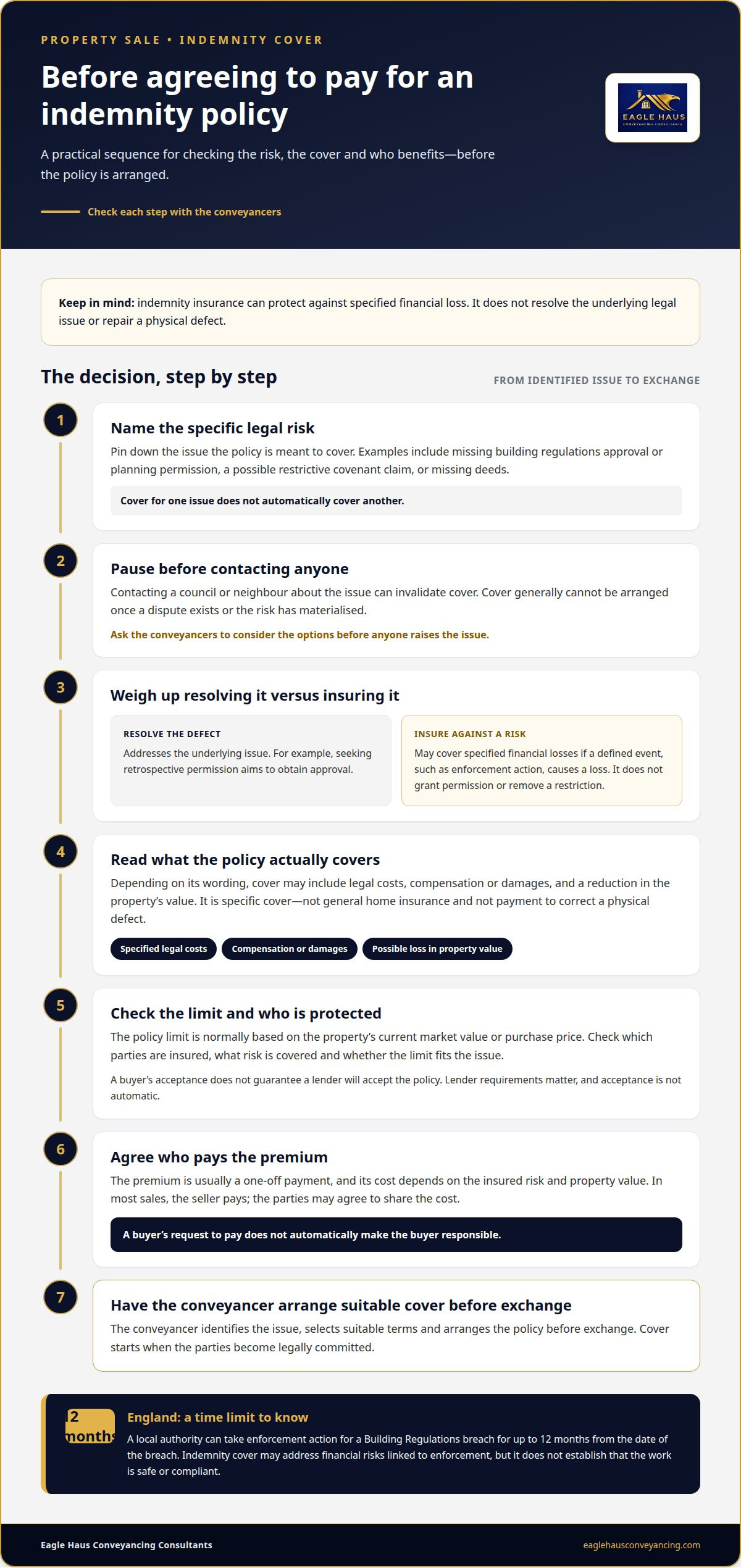
An indemnity policy can protect a buyer financially without fixing the problem that prompted it. If you’re asking what an indemnity policy is, it’s insurance against financial loss from a specific legal issue affecting a property, such as missing paperwork or unauthorised work. In most sales, the seller pays the one-off premium, although the parties may agree to share the cost.
It’s understandable to question a request to pay for cover when the buyer is asking for it. The key is to understand which risk the policy covers, who benefits from the protection and whether the proposed cover addresses the issue identified during the sale.
This guide explains how indemnity policies can protect buyers and mortgage lenders, what they generally don’t cover, and what to consider before agreeing to pay. It also explains why contacting a council or neighbour about the issue can affect the availability of cover, and how the policy fits into conveyancing.
Table of Contents
Buyer wants an indemnity policy, should I pay for it?
In the UK, an indemnity policy is insurance against financial loss from a specific legal issue affecting a property. Sellers usually pay the one-off premium in a sale, although the parties can agree to share the cost.
What an indemnity policy covers
House indemnity insurance covers specified financial losses linked to a legal risk, rather than repairing the property. Depending on the policy, it may cover legal costs, compensation or damages, and a reduction in the property’s value.
For example, cover may relate to missing building regulations approval or planning permission, a potential restrictive covenant claim, or missing deeds. The policy wording identifies the risk and the protection provided, so a policy for missing approval won’t automatically cover another legal issue.
When property transactions use indemnity insurance
Buyers and sellers may use indemnity insurance when important property paperwork is missing or historic work has no evidence of permission. Examples include a missing building regulations certificate for replaced windows or a title that raises concerns about a restrictive covenant.
In England, a local authority can take enforcement action for a Building Regulations breach for up to 12 months from the date of the breach. A policy may address financial risks linked to enforcement, but it doesn't establish that the work is safe or compliant. The buyer's conveyancer may raise cover as part of the transaction.
Resolving a defect or insuring against it
Resolving a legal defect addresses the underlying issue; insurance provides financial cover if a defined risk causes a loss. For instance, seeking retrospective permission aims to obtain approval, while an indemnity policy may cover specified losses if enforcement action follows.
These options are not interchangeable. Contacting a council or neighbour about the issue can invalidate an indemnity policy, and cover generally cannot be arranged once a dispute exists or the risk has materialised. Before anyone makes contact, the conveyancers can consider whether resolving the issue or arranging insurance better suits the transaction.
The limits and value of cover
A policy’s limit is normally based on the property’s current market value or purchase price. The premium is usually a one-off payment, and its cost depends on the insured risk and property value. In most sales, the seller pays, although the buyer and seller sometimes agree to share it.
Cover is specific, not general home insurance: it doesn’t resolve the title issue or pay to correct a physical defect. The conveyancer identifies the issue, selects suitable policy terms and arranges cover before exchange, so it starts when the parties become legally committed. If a purchaser asks you to pay, consider the risk covered, the policy limit and whether the terms address the issue identified.
Benefits for buyers, sellers and lenders
An indemnity policy can help keep a property sale moving when a legal risk concerns the buyer or mortgage lender. Its value depends on the specific issue, the policy wording and whether the lender accepts the cover.
For a buyer, cover may reduce the financial impact of a claim linked to a legal defect. For example, a restrictive covenant policy may cover legal costs, compensation, compliance costs and a fall in property value if someone enforces the covenant. A policy concerning missing planning permission may cover defined losses arising from enforcement action. It doesn’t grant permission or remove the restriction.
A seller may benefit too. Offering suitable cover can help address a buyer’s concern about a past alteration or missing document, rather than leaving the issue unresolved during negotiations. The policy may also protect future owners, depending on its terms. This can make cover relevant beyond the immediate sale, although the wording determines who is insured and which risks are included.
For a lender, the central concern is the security behind its mortgage. Legal uncertainty affecting ownership, access or compliance could affect that security. Insurance may protect the lender’s financial interest if the specified risk causes a loss. Some mortgage lenders require cover when a transaction presents legal uncertainty, but acceptance is not automatic. A lender may reject a policy that doesn’t meet its requirements, leaving the parties to consider another solution.
Lender acceptance is therefore a practical decision, not an administrative detail. The conveyancers need to identify the issue, confirm that the proposed policy addresses it and establish whether its terms meet the lender’s requirements. A policy accepted by a buyer might still be unsuitable for the lender. The insured parties, indemnity limit and type of risk covered can all matter, with lending specialists like VIR Advisory noting that satisfying strict security prerequisites is vital for any property finance approval.
Does making a claim under an indemnity policy require notifying the council or another third party? A claim follows the policy’s claims process; contacting the council or another third party about the underlying issue is different. Such contact can invalidate cover, so the policyholder should get legal advice before responding to correspondence or raising the issue.
Before agreeing to pay, consider what protection the buyer and lender receive, and whether the policy wording matches the identified risk. Clear property conveyancing support can help explain how the policy fits the transaction and its mortgage requirements.
Who pays for the policy
In most UK property sales, the seller pays the indemnity policy premium. The buyer and seller can sometimes agree to share it, so a purchaser’s request doesn’t automatically make the buyer responsible. Agree who will pay before the policy is arranged, particularly if exchange is approaching.
The seller often pays when the policy addresses a historic issue connected with the property being sold. For example, the buyer might request cover because documents for past building work are missing or because the title raises concerns about restrictive covenants. The seller’s payment can help address the concern and keep negotiations moving, but the policy still needs to cover the specific risk.
Payment is a transaction decision, not a measure of who benefits most. A buyer and mortgage lender might receive protection under the policy while the seller pays the premium to help the sale proceed. In another negotiation, the parties might share the cost. The buyer’s request, the seller’s position and the lender’s requirements all help shape the agreement.
The premium is normally a one-off payment, rather than a recurring monthly charge. Its amount depends on the insured risk and the property’s value. A policy concerning a missing certificate is not necessarily priced like cover for a title restriction, because the risks differ. The insurer’s terms also define the cover and who it protects.
Before agreeing to pay, establish what the policy is intended to cover and who will be insured. For instance, a seller paying for a policy that protects only the purchaser might reasonably want that arrangement stated clearly. The conveyancers can record who pays, identify the policy terms and ensure the proposed cover addresses the concern raised during the sale.
Timing matters. A property indemnity policy should be arranged before exchange, so cover starts when the parties become legally committed. If negotiations over payment continue close to exchange, settle the arrangement promptly. Delaying the decision can leave the buyer, seller and lender without agreed cover when it is needed.
If the purchaser asks you to pay, consider whether the premium is a reasonable contribution to resolving the specific concern in the transaction. A seller can agree to pay, propose sharing the cost or discuss another response through the conveyancers. The decision should reflect the policy’s scope, the parties’ agreement and any mortgage lender requirement, not an assumption that the requester must pay.
How indemnity policies protect against legal defects in property titles
A property title sets out legal rights and restrictions affecting ownership. During conveyancing, a missing deed, unclear access right or potential breach of a restrictive covenant can raise concerns for buyers. An indemnity policy may protect against specified financial loss if the legal defect leads to a claim. It doesn’t change the title or create a right that was never recorded.
For example, a property may have used a driveway for years, but its title documents don’t record a formal right of way. An absence of easement policy may cover financial loss if access is challenged, including specified legal costs or compensation. A missing deed of easement may also prompt a policy request when no dispute exists. The policy responds to the insured risk, not every issue connected with the property.
Restrictive covenants create a different title risk. These promises run with the land, so a later owner may face a claim over work that breached a covenant. A policy may cover the cost of defending enforcement, compensation, compliance costs or a reduction in value. It doesn’t remove the covenant or authorise the work. The terms need to identify the relevant breach and the parties protected.
Insolvency can also affect a property transaction involving a gift or sale at an undervalue. According to The National Archives, in England a trustee in bankruptcy can apply to the Court to set aside a property gift or sale at an undervalue if the owner becomes bankrupt within 5 years. This risk may matter when reviewing a title’s ownership history and the circumstances of a transfer.
Other title concerns can include missing deeds or historic planning documents. A policy may help with financial losses arising from a legal challenge over such paperwork, provided the issue fits the cover and no dispute has already arisen. Chancel repair liability is another potential title-related concern: some properties in England and Wales may have to contribute towards church repairs. Specific cover can insure against that identified liability.
For buyers, the practical value is protection from a defined financial consequence, not a clean title. A policy may help address a lender’s concern and support a purchase where legal uncertainty remains. Its limit is generally linked to the property’s current market value or purchase price. The policy schedule and wording show which defect, legal costs and losses it covers.
Conveyancing due diligence still matters. The conveyancer examines the title, identifies the legal risk and considers whether insurance fits the circumstances. If a council, neighbour or rights-holder has already challenged the issue, the risk may have materialised and cover may not be available. A policy transfers specified financial risk; it doesn’t settle a dispute or repair a defect.
How indemnity policies protect purchasers
For a purchaser, indemnity insurance can provide financial protection if a defined legal defect leads to a claim or loss. It shifts specified financial risks to the insurer, subject to the policy terms. It doesn’t make the title defect disappear, guarantee that a claim will succeed or provide general cover for every problem discovered after buying.
The practical benefit depends on matching the policy to the risk. A solicitor identifies the legal issue, then reviews the insured parties, exclusions and cover limit. If a restrictive covenant is the concern, the wording needs to address that covenant and the potential enforcement risk. General wording about property defects would not, by itself, show that a particular title issue is insured.
Cover may help protect a purchaser against a reduction in the property’s value caused by the specified issue. Depending on the policy, it may also meet legal costs for defending a claim, compensation or damages, and certain costs of complying with a legal requirement. These protections matter if a future challenge creates expenses that would otherwise fall on the owner.
For example, a title concern may prompt the purchaser’s solicitor or mortgage lender to require insurance before proceeding. A policy can help address the identified financial risk without resolving the underlying defect. This distinction matters: insurance doesn’t confirm that past work was safe, create a missing legal right or cover a physical fault in the building.
Some residential policies automatically protect future owners and lenders, and most last indefinitely. The purchaser should still understand who the policy covers and whether its terms extend to later owners. A future sale may bring the issue back into view, so keeping the policy documents with the property records can help a later conveyancer understand the protection arranged.
Indemnity insurance has important boundaries. It generally won’t cover a problem already known and disclosed during the sale, an existing dispute or a risk that has already materialised. Contacting a council, neighbour or other third party about the insured issue may also affect cover. If correspondence arrives, get legal advice before responding.
The takeaway for buyers is to treat a policy as targeted financial protection, not a substitute for conveyancing due diligence. The solicitor’s review should connect the title defect, the insured risk and the policy wording. If you’re buying and need help understanding how cover fits your transaction, get conveyancing support for your purchase.
Eagle Haus Conveyancing Consultants
Eagle Haus Conveyancing Consultants supports residential purchases and sales locally, helping you understand how a property issue may affect your transaction. If a buyer requests an indemnity policy or a title concern arises while you’re buying, conveyancing guidance can clarify the issue, the proposed cover and its place in the sale.
The right approach depends on the specific legal risk and the policy wording. Understanding those details can help you discuss the request with the other party and keep the next steps clear. Eagle Haus Conveyancing Consultants also supports transfers of equity, remortgages and company purchases where property ownership or finance is changing.
If you’d like to discuss a property transaction and an indemnity policy request, contact Eagle Haus Conveyancing Consultants.
Make your next property decision with clarity
Before agreeing to a proposed policy, make sure the request is clear in the context of your transaction. Understanding what an indemnity policy is gives you a useful starting point; next, have the specific concern and proposed response set out plainly. That helps everyone involved understand the decision and what remains to be resolved.
Keep the conversation focused on your circumstances, whether you’re buying, selling or changing how a property is owned. Eagle Haus Conveyancing Consultants can help you consider property matters alongside the wider transaction, so you can move forward with a clearer understanding of your options.
Contact Eagle Haus Conveyancing Consultants to discuss your property transaction. A clear conversation can help you take the next step with confidence.
Frequently Asked Questions
What is house indemnity insurance?
House indemnity insurance is a policy covering a defined legal risk connected with a property. Its schedule identifies the issue insured, the people protected and the cover limit. For example, cover might relate to missing paperwork for past work or a title restriction. If you’re reviewing a policy during a purchase, match the stated risk to the concern raised in the conveyancing paperwork.
Can you pass on an existing policy to a new owner?
Many residential policies automatically protect future owners, so a later purchaser may benefit from an existing policy. The wording sets out the terms, including who is insured and whether the relevant risk remains covered. For example, a buyer reviewing a property with historic paperwork concerns should obtain the existing policy documents during conveyancing. This lets the conveyancer establish whether the cover applies to the new owner’s circumstances.
Do indemnity policies fix the underlying issue?
No. A policy provides financial protection against a specified loss; it doesn’t repair a physical defect or change a property’s legal position. For example, cover relating to missing approval doesn’t certify that building work is safe. If a survey identifies a physical fault, insurance for a legal risk is not a substitute for addressing it. Keep the legal issue and the property’s condition separate when considering the cover.
Does the policy fix the problem?
No, an indemnity policy doesn’t remove a restrictive covenant, supply a missing deed or grant retrospective permission. It responds financially if the insured issue causes a covered loss. This distinction matters if you’re buying a home in Staffordshire and a title concern arises: insurance may address financial exposure, while the underlying right or restriction remains. The policy wording describes the protection, not a change to the title.
How long does the cover last?
Most residential property indemnity policies last indefinitely, and many automatically protect future owners and lenders. The policy documents state the duration and any conditions that apply, so retain them with the property records after completion. If you later sell or remortgage, give the conveyancer the existing policy to assess its terms alongside the transaction. Cover remains specific to the legal risk described in the policy.
What is an indemnity policy, in simple terms?
In simple terms, what an indemnity policy is can be explained as financial protection against a particular legal risk involving a property. It may help with covered losses if that risk leads to a claim, but it doesn’t make the risk disappear. For instance, insurance might address a defined concern about missing property documents. The policy wording explains the issue insured and the limits of protection.
What is the benefit of taking out an indemnity policy?
The main benefit is financial protection if a specified property issue leads to a covered claim or loss. Depending on the policy, cover may include legal costs, compensation or a reduction in property value. It can also help address a buyer’s or mortgage lender’s concern during a transaction. Its usefulness depends on the insured risk, the policy terms and whether the lender accepts the proposed cover.



Comments