Selling in Birmingham: Service Charges Once Sale Agreed

Agreeing a sale doesn’t end your service-charge responsibilities. If you’re wondering whether to pay a service charge once a sale is agreed, keep managing the account while your conveyancer establishes what is due and how charges will be handled around completion. Don’t assume the buyer takes over the bill as soon as you accept an offer.
It’s understandable to want a clear figure before moving on, especially if the managing agent has raised an urgent repair or unexpected cost. The amount and timing can depend on the building’s accounts, the lease and the sale arrangements. Keep service-charge statements and correspondence together, and pass them to your conveyancer promptly.
This guide explains what to do after agreeing a sale, how to handle service charges and urgent costs, and what information can help clarify payment responsibilities. It also covers what to do if you’re worried about meeting a charge or lack cover, so you can understand the next steps towards completion.
Table of Contents
4. Who pays the service charge between exchange of contracts and completion?
5. How are service charges apportioned on completion when selling a leasehold property?
5. How can a buyer check for service charge arrears, disputes or planned major works
Eagle Haus Conveyancing Consultants: Residential Purchases and Sales
3. Service charge liability after sale in England and Wales
Accepting an offer does not, by itself, transfer a leasehold home or settle its service-charge account. If you’re deciding whether to pay a service charge once a sale is agreed, the lease, sale contract and completion arrangements all matter. The sale paperwork and completion arrangements help determine how charges are handled between seller and buyer.
The lease sets out the service-charge obligations attached to the flat. It may explain who pays the landlord or managing agent, how charges are demanded and when payment is due. The sale contract and completion arrangements address the change of ownership. These documents work together, so an accepted offer or a new bill alone does not give the full answer.
For example, a managing agent might issue a demand before completion for a period that continues beyond the seller’s ownership. The seller may remain named on the account until the transfer is recorded, while the parties account for the relevant period through their completion arrangements. The conveyancers need the demand, the period it covers and the completion date to calculate any adjustment.
Keep the paperwork moving as soon as the sale is agreed. The seller should pass on current service-charge demands, statements and correspondence from the landlord or managing agent. The buyer’s conveyancer can use those records to understand the account and raise any points that affect the transaction. If a new demand arrives during the sale, send it promptly rather than assuming it will be picked up automatically.
A demand may relate to an earlier period, an estimated contribution or a balancing charge issued after accounts are prepared. If you’re asking whether to pay a service charge after agreeing a sale, the invoice date alone does not show which owner should bear each part. Conveyancers can consider the period covered, the lease and any agreed apportionment, then reflect the outcome in the completion figures.
As a buyer, ask your conveyancer how the current account will be dealt with before completion. This includes checking for unpaid demands, credits, disputed sums and requested charges that have not yet been paid. As a seller, providing complete records helps avoid late questions and gives both sides a clearer basis for agreeing the completion statement.
Share service-charge demands and account statements with your conveyancer.
Identify the period each demand covers, not just its issue date.
Flag arrears, credits, disputed charges or expected balancing sums.
Make sure the completion arrangements deal with the account between both owners.
Once completion takes place, the buyer takes over the leasehold interest and the account can be updated to reflect the new owner. The landlord or managing agent may need the transfer details to update its records and direct future demands correctly. Until that administrative update is made, keep copies of completion information and service-charge correspondence so account records do not cause confusion about payment responsibilities.
4. Who pays the service charge between exchange of contracts and completion?
Exchange and completion are separate milestones in a leasehold sale. Exchange makes the sale contract binding, but it does not by itself explain how a service-charge demand should be divided. The lease, contract and completion arrangements provide the details for that transaction. If you’re deciding whether to pay a service charge once a sale is agreed, share the relevant paperwork with your conveyancer.
During the sale, the managing agent may still address demands to the seller. That does not necessarily determine how the charge is shared between seller and buyer. For example, a demand could arrive after exchange and cover a period extending beyond completion. The invoice date alone cannot show how the parties have agreed to account for it.
After agreeing a sale, the seller should forward each new demand to their conveyancer promptly. Include the complete notice, its due date and the period it covers. The conveyancer can review it alongside the contract and expected completion date. If the buyer’s conveyancer needs supporting information, timely replies help keep the completion statement accurate.
It helps to distinguish paying the managing agent from allocating the charge between the parties. One party may pay a demand to keep the account current, while the conveyancers account for each party’s share through the completion arrangements. The paperwork should show whether a payment, credit or adjustment is included. Paying an invoice does not, by itself, settle how the cost is allocated between buyer and seller.
Consider a seller who receives a demand shortly before completion. It may cover a period that begins before completion and continues afterwards. The conveyancers can use the coverage dates, lease and agreed arrangements to establish how it should be treated. If the bill is estimated or later adjusted, they may also need to account for a balancing amount when the final figure becomes available.
Buyers should raise uncertainty with their conveyancer before completion, especially if the seller has reported arrears or challenged a demand. Sellers should not leave an outstanding notice unshared. If you’re asking what to do about paying a service charge the moment a sale is agreed, send the demand and account correspondence to your conveyancer, then ask how the charge will be handled in the completion statement.
Send each new service-charge demand to your conveyancer promptly.
Keep the notice and account details showing the period covered.
Ask how the contract and completion statement handle the charge.
Keep evidence of any payment, credit or agreed adjustment.
Before completion, the conveyancers can clarify the treatment of charges that span the handover date. If the allocation remains unclear, conveyancing support for a property sale can help address the service-charge details alongside the transaction paperwork.
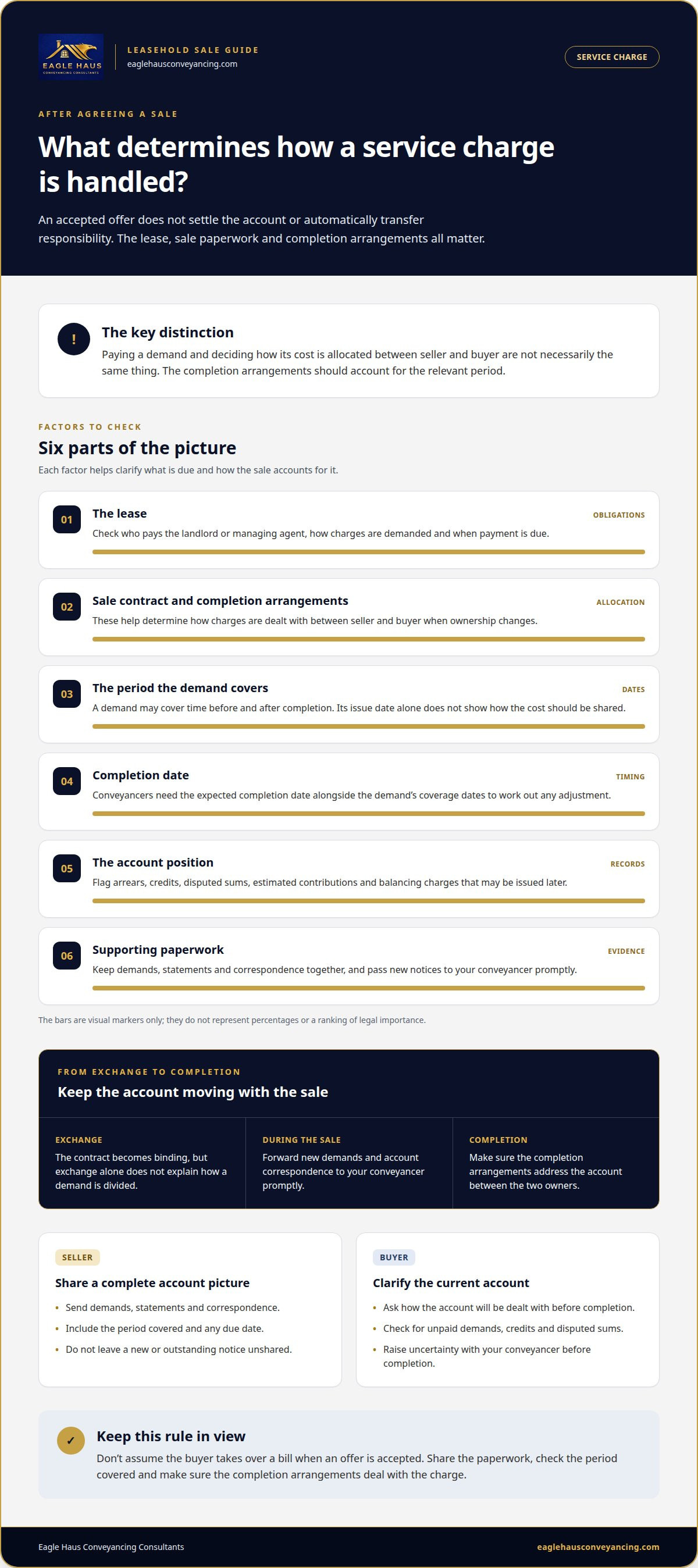
5. How are service charges apportioned on completion when selling a leasehold property?
Apportionment is how the seller and buyer account for a service charge covering time on both sides of completion. Conveyancers use the demand, its service period and the agreed sale terms to prepare any adjustment. The lease and contract matter, so there is no single calculation for every flat or sale.
Start with the service-charge statement. It should show the amount demanded, the period covered and whether it has been paid. A statement for a period wholly before completion raises a different issue from one covering time both before and after completion. Conveyancers need these details to determine how the charge should appear in the completion statement.
For a charge paid in advance, conveyancers can identify the parts relating to the seller’s and buyer’s ownership periods. They use the completion date and charge period to discuss any adjustment under the contract. The calculation should follow the agreed treatment, rather than assume every managing agent uses the same approach.
For example, a seller may have paid a quarterly demand before completion, although the period continues afterwards. The conveyancers can calculate the share attributable to the period after completion and include the agreed adjustment in the completion figures. If the demand covers a period ending before completion, they can instead establish whether any amount remains unpaid and how the contract treats it.
An unpaid demand needs careful handling. The conveyancers should establish what the landlord or managing agent has billed, which period it covers and whether the seller disputes any part. They can then address the account in the sale arrangements. A buyer should not assume an adjustment automatically updates the managing agent’s records. Payment and allocation between the parties are related but separate matters.
Estimated charges need particular attention. A managing agent may later issue an updated account showing that the amount paid differed from the final charge for the relevant period. Conveyancers can consider whether the contract addresses later adjustments and what records will help both parties understand them. Keep the original demand, proof of payment and any later statement together.
Send the conveyancer the demand and statement showing the charge period.
Provide proof of payment or details of any outstanding balance.
Point out credits, disputed sums or later adjustments in the account.
Ask how the proposed apportionment will appear in the completion figures.
Before completion, review the draft completion statement alongside the service-charge documents. Check that it identifies any adjustment and the demand or period it relates to. If the managing agent issues a revised figure during the transaction, send it to your conveyancer promptly. An older statement may no longer reflect the current account position.
Keep copies after completion, including the final statement and documents showing how any adjustment was calculated. If the managing agent later contacts the former owner about a demand, those records can help establish whether it concerns a past period, a later adjustment or an account update. Clear paperwork helps resolve questions without confusing the charge period with the date the demand arrived.
5. How can a buyer check for service charge arrears, disputes or planned major works
Before committing to a leasehold purchase, ask your conveyancer to review the service-charge information supplied for the flat. The account may reveal unpaid demands, credits, disagreements with the landlord or managing agent, and building work under discussion. Each point can affect your understanding of the property’s ongoing obligations.
Start with the account statements and demands. They show what has been billed, which periods the charges cover and whether the seller’s account appears up to date. If a statement shows a balance, ask your conveyancer whether it represents an unpaid demand, a disputed amount or a later adjustment. Each has different implications for the transaction.
Arrears need a clear paper trail. The conveyancer can review demand notices, payment records and correspondence between the seller and managing agent. For example, a demand might remain outstanding because the seller disputes an item. Before deciding how it affects the purchase, the buyer should understand what is challenged, what response has been received and how the matter is being addressed.
Disputes may concern how a charge was calculated, when it is due or what it covers. Look for written explanations, complaint responses and account corrections in the supplied papers. A disagreement said to be resolved should be supported by correspondence or an updated statement. If an issue remains unresolved, the conveyancer can ask focused questions about its status and effect on the account.
Planned major works deserve separate attention from routine maintenance. Ask your conveyancer to review notices, estimates, meeting records and other documents about proposed repairs or improvements. For instance, a building may need external repairs that are being discussed but not yet billed. The available information can help establish whether the work is proposed, approved, underway or complete.
Check the timing and status of each project, not just its name. A completed project may still have a final account to follow, while early plans may change as the landlord or management body gathers information. Ask whether the papers identify the affected parts of the building, the intended work and any expected contribution for the flat. Do not treat an estimate as a final demand.
A reserve or sinking fund may also appear in the service-charge records. The account can show whether money has been collected for future building expenses and whether documents describe its intended use. That information does not, by itself, answer every question about planned works. Your conveyancer can consider it alongside the building’s plans and lease provisions.
Ask your conveyancer to review statements, demands and payment records.
Identify any balance and establish whether it is disputed or unpaid.
Read correspondence about complaints, account corrections or unresolved issues.
Separate proposed works from approved, current or completed projects.
Keep reserve-fund details alongside information about planned building work.
For a Birmingham leasehold purchase, clear answers about arrears and building plans help you assess the documents before proceeding. Get conveyancing support for a leasehold purchase to have service-charge enquiries considered as part of the property transaction.
Eagle Haus Conveyancing Consultants: Residential Purchases and Sales
Eagle Haus Conveyancing Consultants supports residential purchases and sales, including leasehold transactions where service-charge records can raise questions. If you’re selling in Birmingham, conveyancing support can help bring the sale documents, service-charge information and completion arrangements together. Buyers can also have arrears, disputed demands and planned works reviewed as part of their purchase.
Get in touch when you’re preparing to buy or sell, or when a service-charge issue needs attention during the transaction. Sharing relevant property and account information helps start a focused discussion about the conveyancing work involved. Contact Eagle Haus Conveyancing Consultants to discuss your residential purchase or sale.
Move your property transaction forward with clarity
Once a sale is agreed, organising property paperwork can make the next conversations more focused. If you’re still asking whether to pay a service charge after agreeing a sale, share the relevant demand and account correspondence with your conveyancer early. This gives them a clearer starting point for addressing the details alongside the sale.
The same careful approach can help with other ownership changes. Eagle Haus Conveyancing Consultants also handles Transfers of Equity and Remortgages, where clear property records support the legal process. For a sale or purchase, conveyancing support can help you understand the steps ahead and keep the transaction moving.
Arrange a conversation about your property transaction with Eagle Haus Conveyancing Consultants. With the right documents and a clear next step, you can move forward with greater confidence.
Frequently Asked Questions
What steps should buyers and sellers take about service charges after a sale is agreed?
Both parties should involve their conveyancers early and share relevant service-charge information. The seller must obtain a management pack from the managing company that collects the service charge and ground rent. They should also forward new demands or correspondence as they arrive. The buyer can ask their conveyancer to review the pack and raise unanswered points before proceeding. Keeping replies and documents together makes follow-up questions easier to resolve during the transaction.
Can a managing agent demand an advance service-charge payment when a sale is agreed?
A managing agent may issue a service-charge demand before completion, even for a period extending beyond it. Whether it is due and how the cost is allocated depend on the lease and sale arrangements, so send the demand to your conveyancer.



Comments